

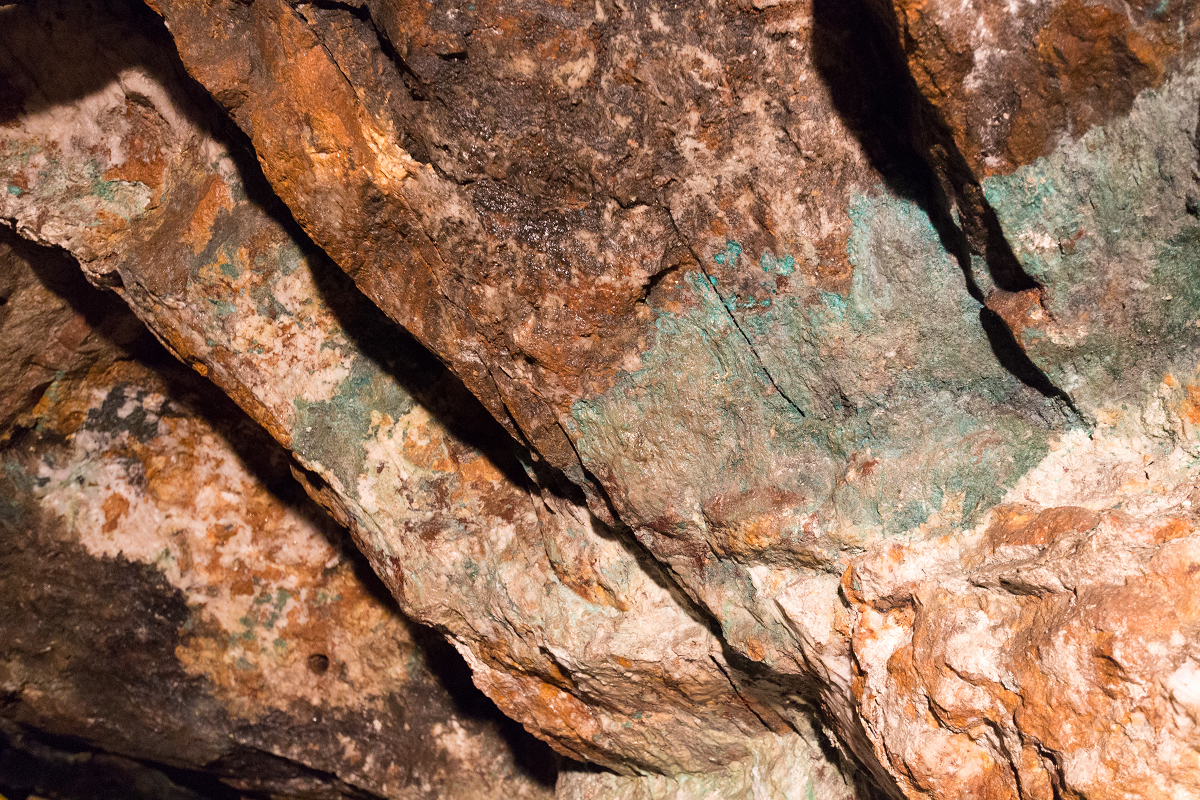
Copper, nicknamed “Dr Copper” as an economic predictor, is now a strategic base metal as the global economy forges ahead towards a sustainable future. Its importance is rated high for many clean energy-related sectors and projects. Over the past few decades, supply and demand have driven price fluctuations, which is sure to keep the reddish-brown metal on the radar of investors worldwide.
Understanding copper
Copper is a chemical element with the symbol Cu and atomic number 29. It is a soft, highly malleable and ductile metal resistant to corrosion, identifiable by its pinkish-orange colour. Copper is an excellent conductor of heat and electricity, thanks to its high thermal and electrical conductivity. It also easily forms alloys with other metals, such as brass and bronze, and is considered the third-most-consumed industrial metal in the world, behind iron and aluminium.
A crucial commodity known for its versatile industrial applications, copper and copper alloys are widely employed in various sectors, from modern electronics to thermal equipment to plumbing and building construction. It is also ideal for coin-making, including for gold and silver coins.
Meanwhile, copper has the enormous advantage of being 100% recyclable. According to the International Copper Study Group, it is one of the few raw materials that can be recycled repeatedly without any loss.
While a growing coalition of countries and businesses have pledged to achieve a goal of net-zero emissions, copper is believed to be a major contributor to the green economy. This is particularly true for electric vehicles (EVs) and renewable energy. More than just a mined metal, copper is essential in addressing some critical issues in sustainable developments and meeting the demand requirements for the energy transition.
Mining and production
Statista.com states Chile is the world’s leading copper producer, with an estimated 5.6M metric tonnes being mined in 2021. Peru ranks second with an estimated production of 2.2M metric tonnes, followed by DR Congo and China. The diagram below showcases major countries in copper mining worldwide in 2021:
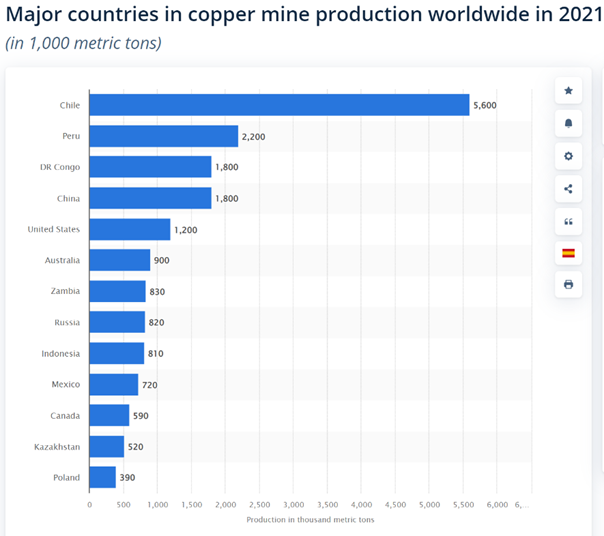
Chile is also home to the three largest copper mines globally (in terms of output), with Escondida at the top of the list. Its capacity in 2021 reached around 1.5M metric tonnes, almost more than double the world’s second-biggest copper mine in Indonesia.
Copper mining is performed either through open-pit (surface) or underground mining. The open-put method is mostly used for mining lower-grade deposits near the earth’s surface. The ground is blasted so that ores can be removed and carried to refineries to extract the minerals. In underground mining, miners blast tunnels into the rock to reach the ore deposits deep within the earth. The ores will be hoisted through vertical shafts and conveyed to the processing plants.
The extraction of copper from the ores is normally carried out in three major steps. The mineral processing involves crushing and grinding the ores to ensure copper minerals are liberated from the gangue. The second step includes smelting or leaching of the concentration to remove impurity elements, followed by the final stage of refining to produce a copper product of 99.99% purity.
Copper is not particularly rare and is one of the most abundant metallic elements in the earth’s crust. In fact, Copper Development Association reports that copper has an estimated concentration between 55 and 70mg/kg. However, most of that copper is too low a concentration to be viable for mining.
Meanwhile, among the small number of major copper-producing countries, the average ore grade has decreased by approximately 25% over 10 years.
The challenge of ore scarcity has driven copper mining companies to find innovative methods and adopt advanced technologies to maximize copper ore extraction or produce copper from low-grade resources. Some major copper players are proactively making investments in transitioning to underground mining. These companies hope to achieve higher production to meet future demand, albeit with greater operating costs.
Copper demand
Copper is arguably the most critical resource in the global economy. The move towards a low-carbon future is anticipated to significantly drive copper demand in areas such as vehicles, wind turbines, and other green energy sectors.
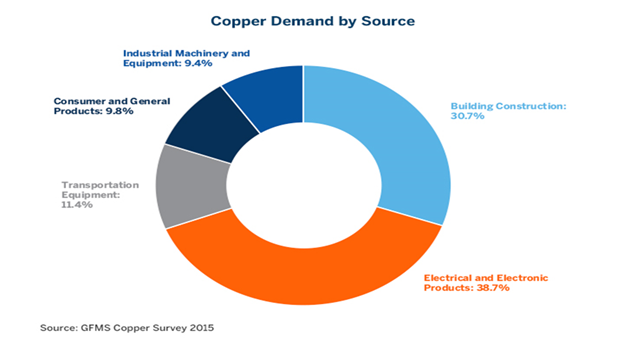
For instance, in December 2021, S&P Global Market Intelligence projected that global copper demand from solar and wind energy generation will reach 852,000 tonnes this year. Meanwhile, the electric vehicle market will account for 1.1M tonnes.
Sales of electric vehicles almost doubled in 2021 compared to 2020, with Chinese buyers taking home 3.3M new electric cars. Meanwhile, Europeans purchased 2.3M, respectively, according to data from BloombergNEF. This will continue to spike copper consumption, given its massive use in EV production.
Although demand for copper in China is forecast to slow down this year due to challenges in the real estate sector and sluggish exports, the mid-to-long-term demand for copper is promising for mining companies. Global demand is estimated to rise 16% by the end of the decade, reaching 25.5M tonnes per annum(tpa) by 2030, compared with a supply forecast showing a 12% decrease versus 2021 levels.
Copper supply
Similar to nickel, copper shortage presents challenges in meeting rising global demand. The copper industry’s supply chain is fragmented, given that 65% of the copper supply comes from just five countries: Chile, Peru, DC Congo, the U.S. and Australia.
Meanwhile, the narrow base of copper’s global supply is also reflected in its processing, with China being a major importer and exporter of refined copper and home to nine out of the 20 biggest copper smelters in the world. The potential for further sanctions on Russia, a major copper mining country, could also cause disruption of supply chains.
Since 2021, major copper mining companies have gradually resumed normal operations after the temporary pause by the Covid-19 pandemic. As Refinitiv data estimated, copper supply is expected to increase about 4% in 2022. Correspondingly, CRU Group also predicted 4.3% growth, helped by new projects and a recovery in production at the world’s largest copper mine Escondida.
However, Chile’s copper production fell 7.5% in February to 394,700 tonnes, as reported by the State Chilean Copper Commission (Cochilco).
Looking forward, copper supply could suffer hiccups as it may not keep up with demand as governments worldwide are pushing for green energy transitions. BMO Capital Markets recently stated that a deficit of 9M metric tonnes of copper by 2030 is forecast.
In May 2022, Ivanhoe Mines also commented that more than 700M metric tonnes of copper would need to be mined in the next 22 years to maintain 3.5% GDP growth. Also important to note that this is without considering the electrification of the global economy, which is the same volume of copper ever mined.
Earlier in 2021, CRU Group also reported that the global copper industry needs to spend more than US$100B to build mines able to close what could be an annual supply deficit of 4.7M tonnes by 2030. Proper investments in copper mining to enhance productivity and optimize operational efficiency is crucial to tackling supply shortages and achieving carbon emission goals in the long-term perspective.
Largest copper mining companies
Chile’s Codelco is the largest copper mining company in the world by production output. The state-owned enterprise operates seven mine sites across Chile, with cathode copper being its principal product. It is also one of the world’s biggest molybdenum producers. According to the company’s annual report, its year-end copper output reached 1.727M metric tonnes in 2021.
Another major player in copper mining is Freeport-McMoRan (NYSE: FCX), headquartered in Phoenix, Arizona. The company ranks in second place with 3.8B pounds of copper mined in 2021, the company’s annual report stated. Freeport-McMoRan’s portfolio of assets includes the Grasberg minerals district in Indonesia, with mining operations in North and South America.
Anglo-Swiss multinational mining and commodity trading company Glencore (LSE: GLEN) is also a leader in the industry, producing 1,195.7kt of copper in 2021. Australia-based BHP Billiton is another mining giant and the operator of the world’s largest copper mine, Escondida, in Chile.
Copper mining’s environmental impact
Like all mining sectors, sustainability remains a top priority for copper miners. The industry actively strives to address sustainability challenges, particularly water scarcity, and mitigate potential environmental consequences of metal extraction.
Although copper-specific international regulations and frameworks are not yet in place, the International Copper Association (ICA) launched Copper Mark. This assurance system assesses miners’ performance on various sustainability parameters for responsible copper production and assists investors in making informed decisions.
More mining companies began to adopt innovative technologies to approach the environmental challenges faced by the industry. For example, Chile’s Codelco has introduced predictive analytics and fully automated loaders to its underground mining operations through collaboration with Sandvik. The company also outlined plans to cut carbon emissions by 70%, reduce inland water consumption by 60% and recycle 65% of its industrial waste by 2030.
BHP has vowed to achieve net-zero operational GHG emission in the second half of this century. The company is using data analytics to reduce copper supply chain emissions. The company also spent $3.43B on a desalination plant to decrease the freshwater needs of its Escondida copper mine.
Copper price history
Copper’s historical price performance has been fluctuating with volatility. Over the past decade, the price of copper hit rock bottom at the beginning of 2016, dropping below US$4,400 per tonne, primarily due to the economic slowdown and stagnant demand in China, a top copper consumer.
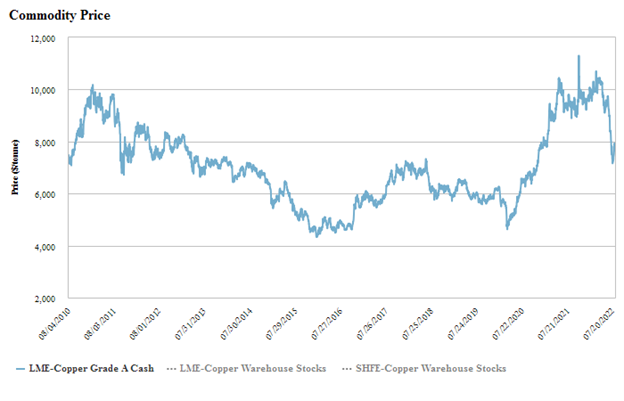
The downtrend didn’t prolong, and the red metal rebounded when the Chinese government rolled out a large monetary stimulus on infrastructure investment, property development and consumer appliances later that year.
Copper prices peaked at around US$7,200 per tonne in December 2017 and continued to be traded at least US$6,800 per pound in early 2018. A strong U.S. dollar is another contributing factor that makes the forecast of all commodities, copper included, remain strong since they are traded and quoted in U.S. dollars.
Copper prices saw a rollercoaster ride from the end of 2018 throughout 2019 as the U.S. and China continued their turbulent trade talks. It crashed in March 2020 due to uncertainties caused by the Covid-19 pandemic. However, during the 2nd quarter of 2021, the copper price skyrocketed to an all-time high, trading above US$11,200 per tonne, up 400% since 2000.
Copper price forecast
In the short term, copper’s performance has seen some inevitable volatility since the beginning of 2022, similar to commodity prices of nickel and zinc, with ever-looming uncertainties of economic growth in global markets due to several reasons, such as the war in Ukraine, risks of Covid lockdowns in China, surging inflation, and rising interest rates.
Meanwhile, World Bank’s price forecasts predict that copper could average US$10,000 per tonne in 2022 before retreating to US$9,700 next year and US$9,000 in 2024, respectively. The outlook prediction is based on constraints including water shortages in Chile, a labour dispute in Peru, and credit issues faced by China’s major smelters.
In the long run, Commodity Insights predicts global demand for refined copper to increase steadily to 31.1 Mt in 2030. As copper demand in the EV and clean energy sectors remains strong at a pace where production cannot keep up in the next few years, analysts from Goldman Sachs predict a bright outlook for the copper market with the red metal’s price rising to $15,000 per tonne by 2025.
If you’re interested in what’s next for this industrial metal, be sure to check out our copper news hub for all the latest mining developments.