
Mongolia is a vast yet under-explored mineral-rich landscape, offering a wealth of opportunity for large scale exploration. What makes it a beneficial jurisdiction for the mining and energy sectors?
Naran-Urchal Tsedev: There was a lot of investment in exploration companies from about 2008 – 2010, and that’s when we first attracted real international money in Mongolia. Mongolia has changed a lot, unnoticed by the global investment community. At TMK Energy, even though we’re gas focused, we’re also involved in energy. The ultimate goal for us at TMK is to produce a new energy source for the country, which could potentially be exported.
We’re practically operating in uncharted waters, with new legislation, which is quite favourable for us. I think that’s one of the key reasons there are three companies who are listed on the ASX developing coal seam gas. For these types of companies, the first thing you do is sign a product sharing agreement with the government that outlines your path. After that, there’s very few things that remain uncertain — it’s very easy to navigate.
Gan-Ochir Zunduisuren: Mongolia has already established itself as a mature mining jurisdiction in East and Central Asia. Mongolia currently exports significant amounts of copper to global markets, mostly China. We also export more than 30Mt of coal (from coke to thermal coal) to China, with Rio Tinto’s Oyu Tolgoi copper mine going underground and boosting production. Xanadu will also soon be a producer with Zijin. I think copper production will potentially triple in the next decade, making Mongolia one of the top 10-15 copper producers in the world, supplying roughly 3-4% of the market.
Despite the focus being on copper and coal, there are lots of different mineral opportunities present in the country. Mongolia is quite under-explored in that regard, including coal bed methane and other critical minerals. If you do systematic exploration in Mongolia, there are many large deposits to be found.
Colin Moorhead: I’m a global explorer and I think in terms of prospectivity; what rocks do we have and are they prospective for the resources we’re looking for? Next, I look at ESG risk; can you build a contemporary and sustainable mine that’s good for all stakeholders in that jurisdiction? Then, of course, is fiscal risk. I see Mongolia as an emerging economy in that regard. Finally, operating and market risk. Where we are in Mongolia; we’re sitting on the doorstep of the biggest customer for our products in the world. I see a real domestic need for gas and energy in Mongolia as well.
In terms of prospectivity, the Central Asian Orogenic Belt runs right through Mongolia and hosts some of the biggest and best deposits in the world. There’s lots of them next door in Kazakhstan and China. I believe the only reason Mongolia doesn’t have them is because we haven’t looked for them yet.
Also, I really congratulate Asian Battery Minerals for accessing the BHP Xplor programme. The biggest company in the world chose eight companies, I think out of 200, and these guys were one of them. So, we’re very proud of you. Well done.
Mongolia generally imposes no limits on foreign ownership of investments, except for foreign state-owned entities. How do you feel the government supports the industry? Are they enablers of the mining and energy sectors?
Gan-Ochir Zunduisuren: I had the opportunity to be on the board of a company called Oyu Tolgoi LLC, which is 34% owned by the Mongolian government, and I was on the board on behalf of the government. Usually if the company finds a deposit, and it’s large enough to impact the economy of the country, then the government has a right to retain up to 34%. But it’s not free, the government has to pay equity into the project and fund the mining. I really think for mineral projects, there is less risk in this regard. For negotiations, they are quite commercial between the government and the investor.
Colin Moorhead: There are many ways to seek rent from a resource and the government representing the community should always do that in a fair and balanced way. The difference is risk. I’ve seen this around the world, where equity risk is quite high, and this is not a non-risk game we’re playing. It’s big capital, long paybacks, and long-term investments. Apples to apples, receiving a royalty is always lower risk than an equity position for a government. Ultimately, mining and energy projects can benefit all the stakeholders in an appropriate way.
There are still several challenges companies face operating in the northern Asian country, such as infrastructure and permitting times. What should companies consider before attempting to navigate working in Mongolia?
Naran-Urchal Tsedev: In-country experience, mostly. I think that’s key. Our team has been quite fast in progressing our project and it all has to do with the in-country experience. To stay investible, you have to be audited and, in tandem, follow governance, which is covered by our Australia team. Having an in-country team, whether it’s a private or public company, who know how to move the projects forward and sees the issues more on a grounded basis, is important. That would help anyone avoid lots of disappointment. That’s where we have the most pros, I would say. With Asian Battery Minerals, we got listed during COVID and still managed to get lots of things done during this time. Team balance is very important in my opinion.
Relative to my home state of Victoria in Australia, things can be done much faster in Mongolia, if you do it the right way, with the right people, and with respect towards your stakeholders
Colin Moorhead: You can’t build an Australian mine in Mongolia; there is potential to experience roadblocks. I don’t consider myself a Mongolia expert but I’m surrounded by people who are. One of the things to be aware of when considering how to get things done in Mongolia, is understanding how hard it is to do stuff elsewhere. Relative to my home state of Victoria in Australia, things can be done much faster in Mongolia, if you do it the right way, with the right people, and with respect towards your stakeholders. It’s one of Mongolia’s great advantages that it takes five to 10 years to get a big copper mine off the ground. Whereas, if I did that anywhere else in the world, it’d probably take 20 to 30 years.
Where are we seeing the most allocation in funding? Do you believe the government is doing enough to support investment into junior mining companies who can grow these projects?
Gan-Ochir Zunduisuren: Governments around the world can shorten the permitting, smoothen the legal relationship between the stakeholders, and on top of that, really improve infrastructure. The Mongolian government is in the process of reforming some of the policies regarding mining, including mining law and other related business laws, as well as improving investment protections.
In 2022, the government introduced the New Revival Policy, which addressed the post-COVID economic environment. That policy addresses three very important things for mining, one of them being infrastructure development within the country. Second is the development of borders. We want to make sure that when we mine the product, it can be moved within the country into the market, then across the border without any delay. Third, is energy supply. These policies will come into fruition within the next five to 10 years. As it is accomplished, I think Mongolian mining will expand much faster.
Colin Moorhead: One of the key areas for improvement is how we nurture the junior company environment in Mongolia. There is a saying ‘no juniors, no majors.’ Zijin came in off the back of Xanadu. BHP put a toe in the water with Asian Battery Minerals, and of course, Ivanhoe’s Turquoise Hill grew the great Oyu Tolgoi story that got Rio Tinto into the country. To do that, you need to be able to peg ground, obtain mining and exploration leases, and add value to those and trade them. Our job as a junior is to advance projects as far as possible, and then facilitate a major mining company to spend billions in the country.
Most of you have mentioned considerations of stakeholders in your projects. Can you expand on key ESG considerations for companies looking to operate in Mongolia?
Naran-Urchal Tsedev: It depends on who’s perspective you’re looking from, because gas is a fossil fuel. So, from certain perspectives (in terms of the environment), some investors would argue that, but if you come to Mongolia and realize that people are burning coal for the cold months, and if you convert that into gas, it would be 95% cleaner. We know that what we’re trying to achieve is a transitional energy source, it’s not the ultimate goal. Maybe renewable or something cleaner would be preferable, but until we get there, we need this fuel for transitioning.
As for the local communities, they’re not really familiar with gas exploration companies, so they treat us like a mining company, but at the end of the day, we’re just drilling a hole. There’s less of a footprint for us. Also, because most of the coal mining happens as open pit, the methane gas is just evaporating into the air. But if you can use the gas in the field for commercial purposes, that’s great.
Gan-Ochir Zunduisuren: I see ESG from three perspectives. One is the market demanding products to be ESG compliant, transparent, and traceable, especially critical minerals, because of their importance in the energy transition. Second is from the company’s perspective. We see ESG as part of our risk assessment and risk management exercise because with a strong ESG component, it enables companies to transition from exploration to development to operation quite effectively compared to other companies. In Mongolia, the companies who succeeded in getting permits and social licences had strong ESG and stakeholder management and collaboration.
Colin Moorhead: ESG is just a fancy term for managing expectations. In my simple model, it’s like a three-legged stool. You’ve got employees who expect you to create work, they trust you with their lives and their livelihoods. For them it’s all about safety, employment, and advancing their families. Next is the community and government expect you to exploit the resource sustainably and in a contemporary way, and that’s using the best energy mix available and minimizing your scope one and two emissions, etc.
I think we are moving forward on that. For the record, I’m a big believer in gas as a transition energy, particularly in Mongolia. Thirdly, the people that provide you with debt and equity have a right to expect a decent return for the risks they’re taking. If you can balance all those things, the stool stands up.
Let’s look at the economic outlook for Mongolia. Do you think it bodes well for future projects hoping to begin operating in the region?
Colin Moorhead: Oh, absolutely. If juniors like us can commercialize a discovery and bring in a major investment from a large mining company, it shows the world that Mongolia is open for business. The government recognizes the issues and is working towards addressing them, with elevated foreign direct investment in mining as its key priority. All of the infrastructure investment down south, around the borders, and road and rail, is fantastic. Mongolia is evolving and has a very bright future in front of it.
Gan-Ochir Zunduisuren: With the expected arrival and implementation of new policies, I think the Mongolian economy will improve. Currently, GDP growth is about 6-8% annually. It’ll progress further, but one thing I would like to point out, is how it’s improved from an economic productivity point of view in the last decade. Especially for large projects in the mining sector, like Xanadu’s Kharmagtai, there are already human resources available.
If you look at Oyu Tolgoi, where lots of different companies come in to look at the practices, 96% of the workforce there is Mongolian. That shows how the Mongolia workforce is ready. If it’s juniors or majors that come in, the economy is well-prepared.
Naran-Urchal Tsedev: One of the things that goes unnoticed is that [the Mongolian] local capital market grew about tenfold in the last five years. It was at about US$300M in market cap and now it’s about US$3B. One of the key reasons for that is that all the major banks are listed. Something I’ve noticed is that Mongolians are becoming shareholders and investors themselves. What they’re demanding is a change in legislations, capital market laws, and investor protection, which is really beneficial for international investors as well. At the end of the day an investor is an investor.
There’s a really big change and as more people become capital market participants, our economy grows, and not just in the mining sector.
Are we seeing interest from local investors into domestic projects or is it more international?
Colin Moorhead: I was really interested to hear about the growing retail investors on the local exchange. I had much more experience with Indonesia where I’ve seen it go from nowhere to a massive exchange which attracts money from all over the world. If we can create the conditions for that to occur in Mongolia, it’ll be a magnificent outcome because at the end of the day, people are agnostic about which exchange they put their money in.
The other strong point that was made was about labour and human resources. At the end of the day, you need mineral resources, human resources, and capital resources in that order. I think the country and the industry have done a great job of educating and training. As I said before, you don’t build an Australian mine in Mongolia, you build a Mongolian mine in Mongolia; owned, operated, and run by Mongolians. And that’d be a great outcome.
Gan-Ochir Zunduisuren: From my experience, if you compare it to 10 years ago, lots of Mongolian capital is available and invested into the country. Just an example, in two rounds of small raises I did with Australian investors, 15 to 20% were raised from Mongolia. It shows that Mongolians are strong believers in the Mongolian economic story. Plus, the foreign investors feel much more comfortable with an experienced team.
An experienced operation team, management, and board is essential to be able to navigate the risks in that jurisdiction because risk is just perception. You’re just accustomed to operating in that environment with certain risks. In Mongolia, we put three-year olds on horseback, but we don’t put them in the pool or on skis. If you compare us with the Swiss, they probably put their kids on skis at a young age instead. It all depends on how you see things and what you see as a risk.
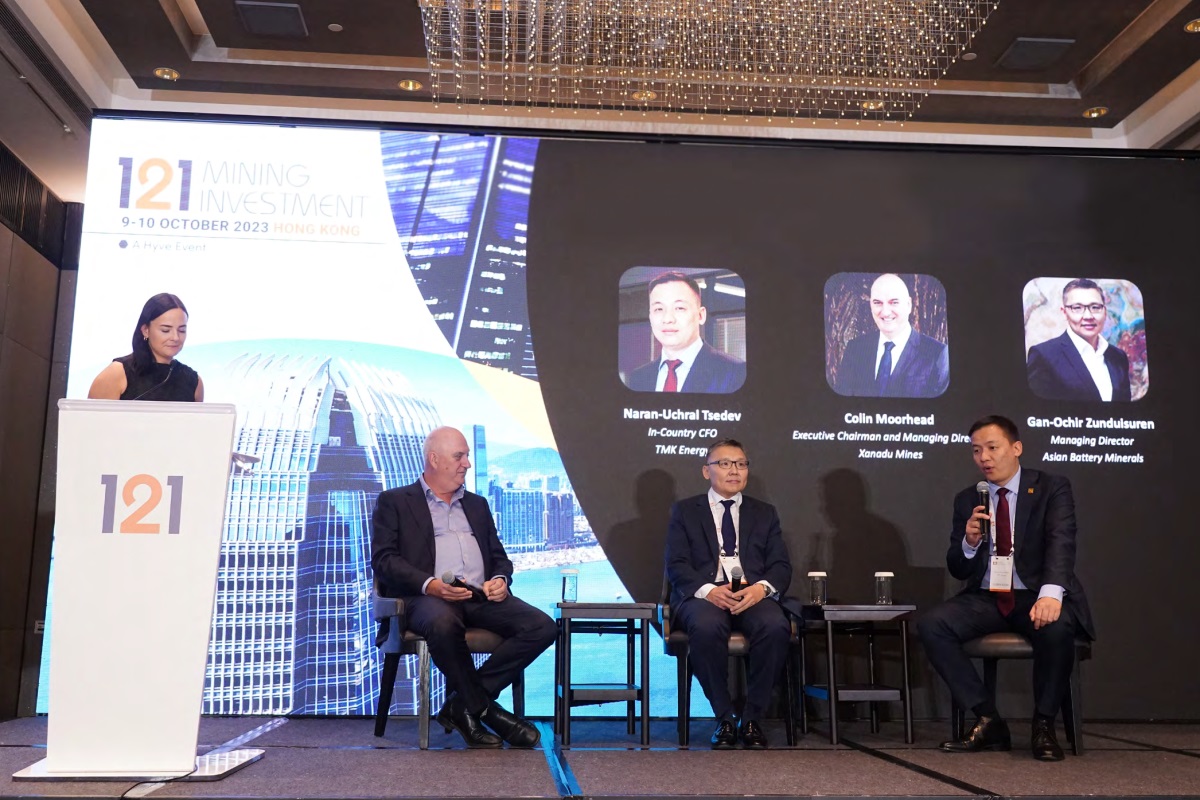
Panel discussion with:
Colin Moorhead, Executive Chair, Head, and Managing Director, Xanadu Mines
Naran-Urchal Tsedev, In-Country CFO, TMK Energy
Gan-Ochir Zunduisuren, Managing Director, Asian Battery Minerals