
With a population of more than 1.4B, a growing middle class, and a government focused on reducing the nation’s CO2 production, India is widely viewed as a major market for electric vehicles (EVs) and the critical minerals that will help build and fuel them.
Up until recently, India was not considered a potential supplier of critical metals such as lithium. However, an announcement by the Indian Geological Survey in February has unveiled what may be a world class resource of critical metals within the country’s borders.
The Geological Survey of India (GSI) revealed it had uncovered an estimated 5.9 metric tonnes of lithium in the Reasi district of the northern union territory of Jammu and Kashmir.
It is an inferred resource because its quantity and quality has been estimated using geological evidence, making the estimates unverified in terms of geological and grade continuity. Nonetheless, this would make India the eighth-largest lithium reserve country in the world after Bolivia (21Mt), Argentina (20Mt), Chile (11Mt), Iran (8.5Mt), Australia (7.9Mt), and China (6.8Mt).
Interestingly, there have been reports the GSI originally mapped and reported the presence of lithium deposits in the Reasi region more than two decades ago, back in 1999.
Great news for Indian PM
Independent non-profit, nonpartisan research organisation, The Peterson Institute for International Economics (PIIE), says the Indian government is eager to bring these resources online as quickly as possible.
“To reach Prime Minister Narendra Modi’s surprising pledge to reach net-zero carbon emissions by 2070, made at the 2021 United Nations Climate Change Conference (COP26), India will have to significantly boost EV adoption and build solar and wind energy capacity,” a recent PIIE report noted.
“India is also trying to become an alternative to China as a producer of lithium-ion batteries, both for domestic consumption—India is the world’s fourth-largest auto market—and eventual export. If successful, India could replicate its success in exporting low-displacement motorcycles and scooters and lower-cost agricultural machinery.”
Modi has established an ambitious target of energy self-sufficiency for India by 2047, a goal no doubt informed by the depth of India’s energy-import dependence. India is able to satisfy only a small fraction of its oil consumption via domestic production (16.5 percent), less than China (27.4 percent) and Europe (28 percent).
India would still have to rely on global markets for other key inputs like nickel, graphite, and manganese, but domestic sourcing of lithium would be a positive start to building some self-sufficiency in energy production and storage, partially shielding Indian EV makers and battery producers from high import prices. Though down from its peak in November 2022, lithium carbonate is currently trading at nearly five times its pre-pandemic price. Domestic supplies would help insulate India from geopolitical risks of rising tensions between China and the United States.
EV push
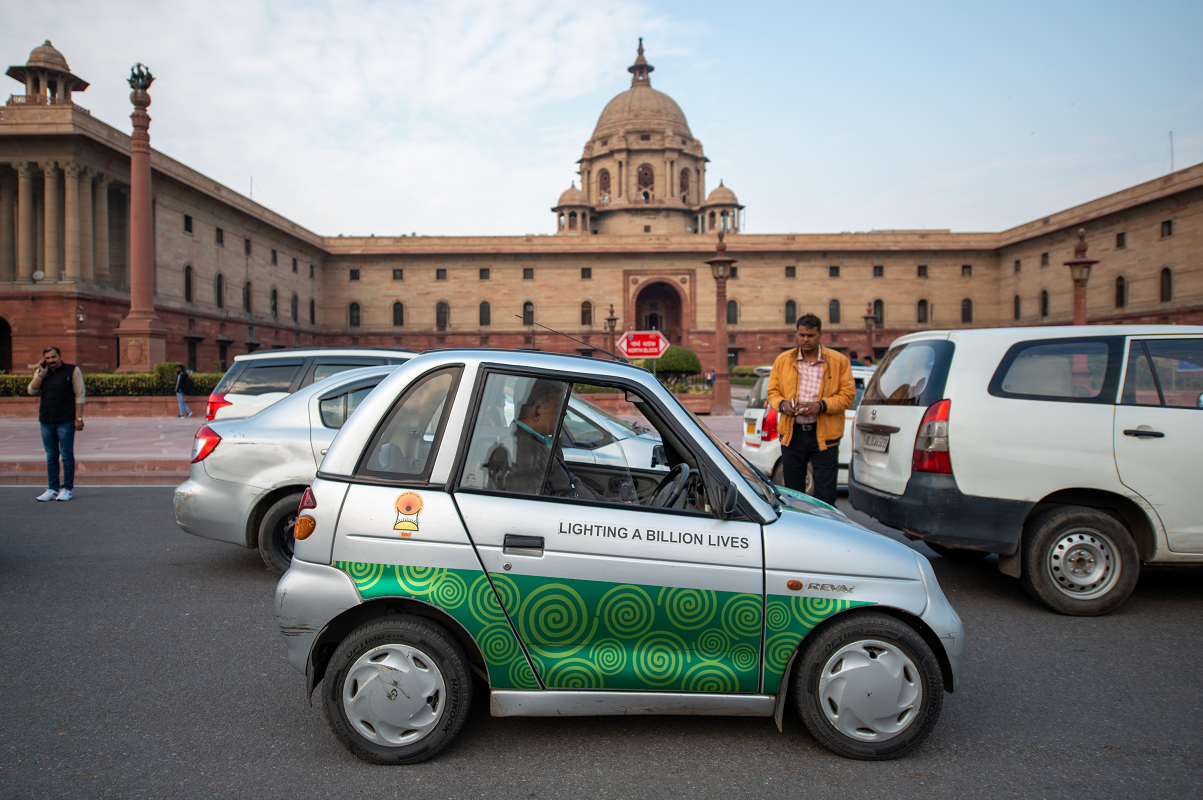
To assist in the acceptance of electric vehicles in the country, the central government has announced a number of promotional measures in the past decade, including tax incentives for electric vehicle owners, public EV charging infrastructure development, and so on.
According to government data from the Ministry of Commerce and Industries, between April-December of 2022-23, India shelled out R₹163B (about U$1.99M) for the import of lithium and lithium-ion.
India has set targets for different types of vehicles to be electric by 2030, including 30 percent of private cars, 70 percent of commercial vehicles, and 80 percent of two and three-wheelers, such as rickshaws.
India broke into the top three largest car markets in the world in 2022 and continues to grow. With over 400M people in need of transport solutions, the Government of India (GoI) is pushing for the adoption of electric vehicles to reduce fuel consumption and improve the environment.
To achieve this, India is part of a handful of countries that support the global EV30@30campaign. This drive aims for at least 30% of vehicle sales to be electric by 2030.
As part of this push, the GoI signed a Memorandum of Understanding (MoU) with Australia in 2022 to source critical minerals. This MoU includes a US$5.8M investment for a three-year India-Australia Critical Minerals Investment Partnership.
The EV30@30 campaign redefines the ambition of the Clean Energy Ministerial’s Electric Vehicles Initiative (CEM-EVI), setting the objective to reach a 30% sales share for EVs by 2030. This will be the benchmark against which progress achieved by all members of the initiative will be measured (i.e., total electric vehicle sales in all EVI countries / total vehicle sales in all EVI countries) and can be met through targets that differ across modes and jurisdictions.
The campaign currently totals 13 member countries and 23 supporting companies and organizations. CEM-EVI participants include Chile, Finland, France, Germany, India, Japan, Mexico, the Netherlands, Norway, Poland, Portugal, Sweden, and the United Kingdom, with Canada and China co-leading.
According to the International Energy Agency, the transportation sector accounts for nearly one-quarter of global greenhouse gas emissions. The EV30@30 Campaign aims to help realize the multiple benefits offered by electric mobility for innovation, economic and industrial development, energy security, and reduction of local air pollution. It sets an ambitious target for electric vehicle sales that, combined with decarbonisation of the power sector, will keep the world on track to meet our shared climate goals for 2050, while improving the quality of life for urban residents.
The campaign supports the market for electric passenger cars, light commercial vans, buses, and trucks (including battery-electric, plug-in hybrid, and fuel cell vehicle types). It also works towards the deployment of charging infrastructure to supply sufficient power to the vehicles deployed.
According to Fortune Business Insights, the India electric vehicle market size was US$1.45B in 2021 and is projected to grow from US$3.21B in 2022 to US$113.99B in 2029, growing at a compound annual growth rate (CAGR) of 66.52% during the 2022 – 2029 forecast period.
Australian partnership
In what looks to be impeccable timing, India and Australia (the world’s leading lithium producer) recently signed a milestone critical minerals investment partnership.
The partnership is working towards investment in critical minerals projects to develop supply chains between the two countries.
Ministers from the two countries have also agreed to deepen cooperation and extend their existing commitments to the Australia-India Critical Minerals Investment Partnership.
Critical minerals was a major focus when Australian Prime Minister Anthony Albanese and Minister for Resources and Northern Australia, Madeleine King, travelled to India. This was all within weeks of the announcement of the massive Indian lithium discovery.
Minister King and India’s Minister for Mines, Shri Pralhad Joshi, held bilateral talks prior to announcing the partnership. The talks identified five target projects (two lithium and three cobalt) on which to undertake detailed due diligence.
Investments under the partnership will seek to build new supply chains underpinned by critical minerals processed in Australia that will help India’s plans to lower emissions from its electricity network and become a global manufacturing hub, including for electric vehicles.
“India’s goals to lower carbon emissions and boost electric vehicle production presents great opportunities and prospects for Australia’s critical minerals sector, for renewable exports and for building stronger supply chains,” Minister King said.
“We are delighted to announce we have completed the first phase of work under the partnership, and taken an important step to building new, robust, and sustainable supply chains between India and Australia for the key battery minerals such as lithium and cobalt.”
“Through market soundings and working with commercial advisers, we have identified five projects on which the parties will proceed to sign non-disclosure agreements and begin undertaking detailed due diligence.”
“Working together, both the nations are committed to reducing emissions, guaranteeing energy security, and diversifying global markets for critical minerals and clean technologies.”
Australia produces almost half of the world’s lithium, is the second-largest producer of cobalt, and the fourth-largest producer of rare earths.
With the expected increase in global demand for low-emissions technologies over the next three decades, this partnership will go a long way towards securing mutually beneficial critical mineral supply chains.